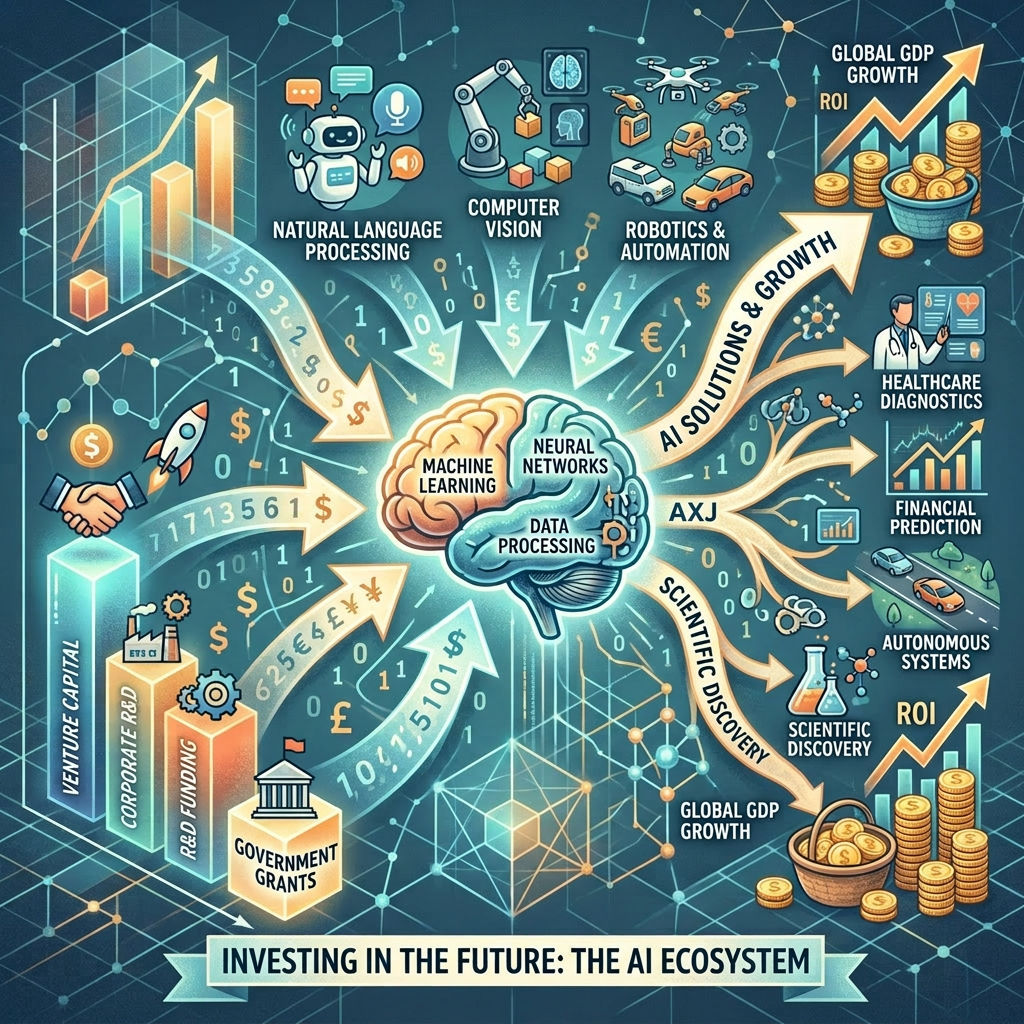
AXJ is your trusted financial advisor when it comes to recommending good solid and secure investments for the future.
AXJ (or AxJ) also refers to “Asia ex-Japan” in investments — a common category for equity exposure to Asian markets excluding Japan. Japan is typically separated because it is a mature developed economy, while the rest of Asia includes a mix of developed (e.g., South Korea, Taiwan, Singapore) and emerging markets (e.g., China, India) with higher growth potential.
www-investopedia-com.translate.googWhy Invest in AXJ / Asia ex-Japan?
- Growth drivers: Rapid economic expansion, rising middle class, tech/AI leadership (semiconductors, electronics), and structural shifts in supply chains.
- Diversification: Reduces reliance on US or global developed markets; offers exposure to dynamic regions.
- Valuations and earnings: Often seen as attractive relative to developed markets, with strong tech and AI tailwinds in recent years. dbs.com.hk
- Risks: Geopolitical tensions (e.g., US-China), currency volatility, regulatory changes in China, and higher volatility than developed markets.
Popular AXJ Investment Vehicle: iShares MSCI All Country Asia ex Japan ETF (AAXJ)This is one of the most liquid and widely used ETFs tracking the region (launched 2008, managed by BlackRock/iShares).
Blackrock.com
- Objective: Tracks the MSCI AC Asia ex Japan Index (free float-adjusted, market-cap weighted). Covers ~10 countries: China, Hong Kong, India, Indonesia, Malaysia, Philippines, Singapore, South Korea, Taiwan, Thailand. Holds hundreds of large- and mid-cap stocks (typically 900+ holdings). schwab.wallst.com
- Key stats (as of mid-June 2026, approximate/recent figures):
- Net assets: ~$4 billion.
- Expense ratio: 0.72%.
- Yield (trailing/SEC): ~1.4%.
- Top countries (approximate): Taiwan (~22-25%), China (~25-30%), India (~15-16%), South Korea (~12%), others.
- Top sectors: Technology heavy (~47-49%, driven by semiconductors), Financials (~16%), Consumer Discretionary, Industrials. money.usnews.com
- Top holdings (examples, weights vary; recent): Taiwan Semiconductor (TSMC, often 12-16%), Samsung, SK Hynix, Tencent, Alibaba, MediaTek. morningstar.com
Recent performance (strong in 2025-2026, driven by tech/AI; check latest for real-time):
- YTD: ~26-33% (outpacing broader categories in many reports).
- 1-year: ~45-56%.
- Longer-term: Volatile but with solid growth potential; 3-year annualized ~14-24% in total return periods. money.usnews.com
Other AXJ options:
- Hong Kong-listed iShares Core MSCI Asia ex Japan ETF (03010 / ISHARES AXJ): Physical replication, popular in Asia for HKD/USD/RMB trading. blackrock.com
- Active funds (e.g., AllianceBernstein or others targeting undervalued AXJ stocks).
- Related ETFs: Country-specific (e.g., EWT for Taiwan, EWY for Korea) or broader EM ex-China.
Considerations for Investing
- Bull case: Tech/semiconductor dominance, India/China recovery, AI capex.
- Bear case: Trade tensions, slowing China growth, currency/EM risks.
- How to access: Trade AAXJ on NASDAQ like a stock (via brokerage). Suitable for long-term diversified portfolios (e.g., 5-15% allocation depending on risk tolerance).
- Always review prospectus, consider costs/taxes, and diversify. Past performance (e.g., strong recent tech-driven returns) is not indicative of future results.
Leave a Reply